
✨ Flat 20% Off on First Order | Use Code: TWINKLE20 • 🚚 100% Free Shipping on All Orders • 🔄 7-Day Size Exchange

Category: Footwear Guides & Sizing

  • Best Winter Shoes for Kids in India: Keep Little Toes Warm, Cozy & Protected

    Best Winter Shoes for Kids in India: Keep Little Toes Warm, Cozy & Protected

    When winter sets in across India—from the sub-zero chill of Himachal, Kashmir, and Uttarakhand to the sharp 5°C to 10°C foggy mornings in Delhi, Punjab, UP, and Rajasthan—keeping young children warm becomes top priority.

    Parents bundle kids in multiple layers: thermal inners, woolen sweaters, beanies, and jackets. Yet, one critical area is often overlooked: their feet.

    Children have a higher surface-area-to-mass ratio than adults and less peripheral body fat in their extremities. When little feet walk on freezing marble, granite, or tiled floors, cold radiates straight through thin socks into their bones. Cold feet cause:

    • Poor peripheral circulation and painful chilblains (itchy, swollen, red toes)
    • Vulnerability to seasonal coughs, colds, and flu
    • Stiff, cramped foot muscles that make walking and running awkward

    If you are shopping for the best winter shoes for kids in India, you need footwear that insulates against freezing floors, blocks cold outdoor drafts, and maintains flexible, anti-skid traction.

    In this winter footwear guide, we explore the best winter styles for toddlers and growing kids, how to pair shoes with thermal socks without pinching, and what to pack for snowy hill station vacations.


    1. The Cold Tile Problem in Indian Homes

    In Western countries, homes are heavily carpeted or fitted with wooden flooring and central heating. In India, however, our homes are purposefully built to dissipate summer heat—featuring cold vitrified ceramic, polished granite, or marble flooring.

    During winter months, these hard surfaces drop to icy temperatures. When toddlers crawl or walk barefoot indoors, their body heat rapidly leaches into the floor via conductive heat loss.

    Indoor Winter Footwear Rule:

    Never let babies or toddlers walk barefoot on unheated Indian tiles between November and February. Keep them in warm fleece-lined booties, high-top padded sneakers, or non-slip silicone gripper socks to keep their core body temperature regulated.


    2. The 3 Best Styles of Kids Winter Shoes in India

    Depending on where you live and your family’s winter activities, choose from these three proven cold-weather shoe designs:

    ① High-Top Padded Leather-Look Sneakers

    Best For: Everyday school wear, casual outings, playground play, and evening park visits.

    • Why They Work: High-top collars rise above the ankle bone, providing an airtight seal that prevents cold drafts from creeping up trouser legs.
    • Features: Padded foam collars cushion the Achilles tendon while synthetic leather or high-density textile uppers block icy winds.
    • Look: Sporty, fashionable, and easily styled with hoodies, denim, and winter jackets.

    ② Fleece-Lined Soft-Sole First Walkers & Booties

    Best For: Babies, crawling infants, and toddlers (0 to 2.5 years) indoors and in strollers.

    • Why They Work: Lined with plush sherpa fleece or brushed cotton that envelopes tiny toes in warmth without stiff, heavy soles.
    • Features: Feather-light construction ensures developing baby tendons can flex naturally while keeping toes toasty.

    ③ Ankle Winter Boots with Lugged Rubber Soles

    Best For: Hill station holidays (Manali, Shimla, Ooty, Darjeeling) and winter morning sports drills.

    • Why They Work: Thick, insulated midsoles create a physical thermal barrier between cold outdoor ground and little feet.
    • Features: Heavy-duty rubber lug treads deliver rock-solid traction on frost-covered roads and dewy grass.
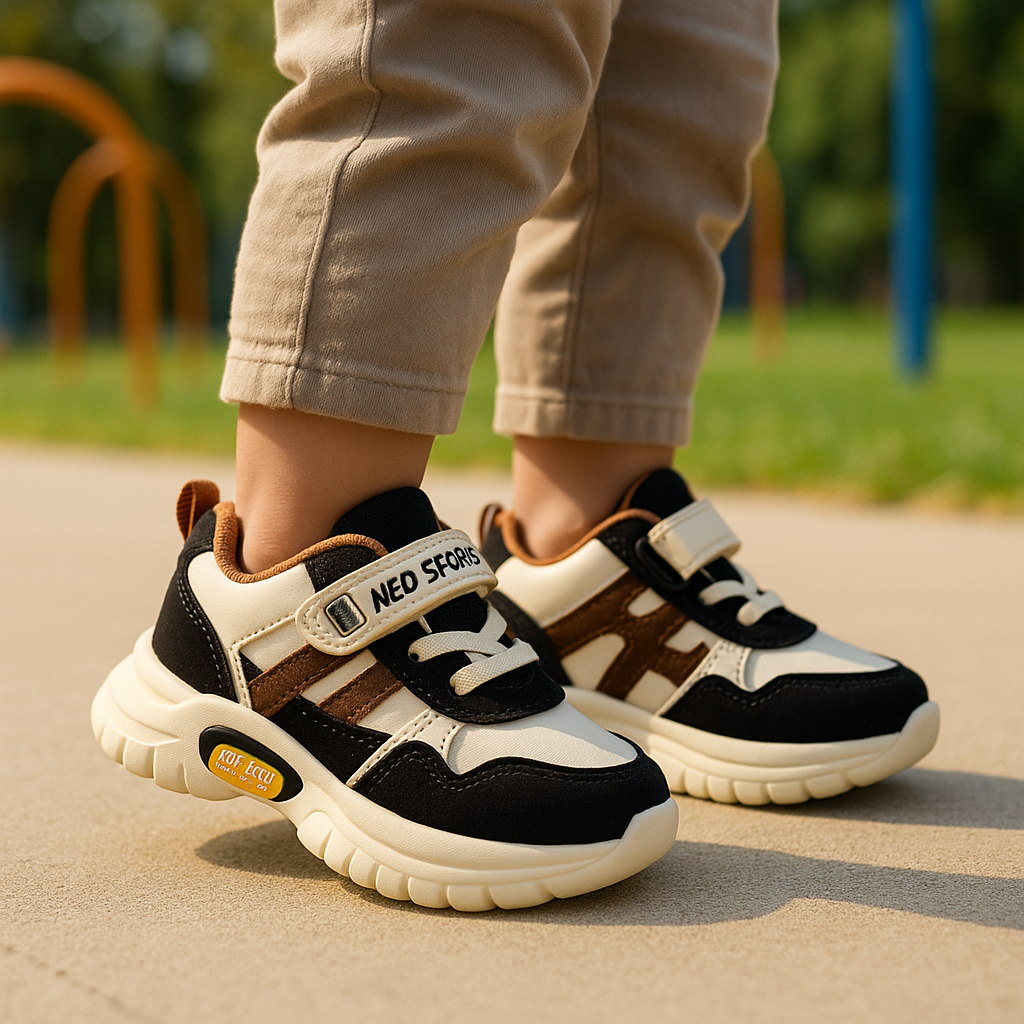
    Kids Playing in Winter Wearing Warm Padded Sneakers
    High-top earth-tone skate sneakers provide both thermal insulation and rugged ankle support for active winter adventures.

    3. What to Look For: The Kids Winter Shoe Checklist

    When selecting winter footwear for children in India, ensure the shoes meet these 5 vital criteria:

    Feature Recommended for Winter What to Avoid
    Upper Material Wind-resistant synthetic leather, dense canvas, or micro-suede Ultra-thin open mesh that lets icy wind blow straight through
    Collar Height Mid-top or High-top (covers ankle bone) Low-cut slip-ons with exposed bare ankles
    Outsole Thickness Thick, cushioned EVA/Phylon sole (1.5 to 2 cm height) Paper-thin, flat cardboard or thin plastic soles
    Outsole Grip Deep rubber lug treads with high anti-slip grip Smooth plastic soles that slide on frosty pavements
    Fastening Easy dual Velcro straps or elastic laces with toggle Fiddly thin laces that little cold fingers struggle to tie

    4. How to Sizing Winter Shoes with Thick Socks (The Sizing Secret)

    One of the most frequent mistakes parents make in winter is packing a child’s foot into their regular summer shoes while wearing thick woolen thermal socks.

    When you stuff a thick wool sock into a tight shoe:

    • Blood circulation is restricted, which actually makes the foot feel colder!
    • Toes are squashed together, leading to friction blisters and ingrown toenails.
    💡 Pro Tip:
    The Half-Size Up Winter Rule: If your child will regularly wear thick terry-cotton or merino wool socks, buy their winter shoes half a size (or 1 full size) larger than their summer barefoot measurement. There should still be a thumb-width (1.0 cm) of wiggle room inside the shoe when wearing winter socks.

    5. How to Prevent Chilblains and Dry Cracked Heels in Winter

    Cold weather can cause uncomfortable skin issues in active kids. Follow these simple daily pediatric care steps:

    1. Avoid Putting Cold Feet Next to Room Heaters: When kids come inside with freezing feet, never place their bare feet directly against electric halogen room heaters or in boiling water. Rapid re-warming causes capillaries to expand too quickly, triggering painful chilblains. Let feet warm up naturally.

    2. Moisturize Nightly: Massage a generous layer of petroleum jelly, coconut oil, or cocoa butter onto your child’s heels and soles before bed, then slip on loose cotton socks to lock in moisture.

    3. Keep Shoes Dry: If shoes get damp from morning dew or winter drizzle, never dry them directly over open heating coils. Stuff them with crumpled paper towels and air dry near a radiator or fan.

    Discover our warm, protective collection of boys high-ankle sneakers and girls cozy trainers crafted for winter warmth and active play.


    Frequently Asked Questions (FAQ)

    Q1. What are the best winter shoes for kids in India?

    High-top padded sneakers with wind-blocking synthetic leather uppers, thick cushioned EVA midsoles, and anti-slip rubber lug outsoles are the best all-around winter footwear for kids in India.

    Q2. Do kids need bigger shoes for winter?

    Yes, if your child will wear thick thermal or woolen socks, you should buy winter shoes half a size to one full size larger to ensure blood circulation is not restricted around the toes.

    Q3. How do I protect my toddler from cold floors at home?

    Use fleece-lined soft-sole booties or anti-skid silicone grip socks indoors. Avoid letting toddlers walk barefoot on unheated marble or ceramic tiles during winter months.

    Q4. Can kids wear regular mesh running shoes in winter?

    Regular summer running shoes have highly breathable open mesh uppers that allow cold winter winds to chill little toes. For winter, opt for closed-weave canvas, high-tops, or synthetic leather sneakers.
  • Kids Shoe Size by Age Chart India: Complete Measurement & Age Guide (Newborn to 10 Years)

    Kids Shoe Size by Age Chart India: Complete Measurement & Age Guide (Newborn to 10 Years)

    Buying kids shoes online in India can feel like a high-stakes guessing game. You browse a gorgeous pair of sneakers, only to be confronted with confusing sizing terms: UK size, Indian size, US toddler, EU 24, or size 5C.

    If you are buying shoes for your own growing child or purchasing a birthday gift for a niece or nephew, your immediate search query is simple: What is the right kids shoe size by age chart in India?

    While age provides a fantastic benchmark, children’s feet grow at drastically different rates! A fast-sprouting 2-year-old might wear an Indian/UK Size 5, while their classmate might still be in a Size 4.

    In this definitive guide, we provide a master Indian kids shoe size by age chart, complete with exact foot measurements in centimeters (cm), UK/Indian sizing, and European conversions. Plus, we’ll share the foolproof at-home paper trace measurement method so you never order the wrong size again.


    1. Indian Kids Footwear Sizing 101: Understanding the Standards

    Before reviewing the age chart, here is the golden rule of footwear in India:

    Important Fact: In India, standard children’s footwear sizing officially follows the UK (United Kingdom) sizing scale. When an Indian brand or e-commerce marketplace lists “Size 4” or “Size 7”, it is identical to UK 4 or UK 7.

    Children’s sizing in India is divided into two broad categories:

    1. Infant & Toddler Sizes (Pre-School): Runs from UK Size 1 to UK Size 9 (typically covering ages 0 to 4 years).

    2. Kids & Junior Sizes (Primary School): Runs from UK Size 10 up to UK Size 13, followed by Adult UK 1, 2, 3, etc. (covering ages 5 to 11+ years).


    2. Master Kids Shoe Size by Age Chart for India (0 to 10 Years)

    Use this handy reference table to match your child’s age group with their average foot length in centimeters (cm) and standard Indian/UK shoe size:

    Child’s Age Group Average Foot Length (CM) Recommended Shoe Insole (CM) India / UK Size EU Size US Kids Size
    0 – 6 Months 8.5 – 9.5 cm 10.0 – 10.5 cm UK 0 / 1 EU 16 – 17 US 1 – 2
    6 – 12 Months 10.0 – 11.2 cm 11.8 – 12.2 cm UK 2 / 3 EU 18 – 19 US 3 – 4
    12 – 18 Months (1 – 1.5 Yrs) 11.5 – 12.5 cm 13.0 – 13.5 cm UK 4 EU 20 US 5
    18 – 24 Months (1.5 – 2 Yrs) 12.8 – 13.5 cm 14.0 – 14.5 cm UK 5 EU 21 – 22 US 6
    2 – 2.5 Years 13.8 – 14.3 cm 15.0 cm UK 6 EU 23 US 7
    2.5 – 3 Years 14.5 – 15.0 cm 15.8 cm UK 7 EU 24 US 8
    3 – 4 Years 15.3 – 16.0 cm 16.8 cm UK 8 EU 25 – 26 US 9
    4 – 5 Years 16.3 – 17.0 cm 17.8 cm UK 9 / 10 EU 27 – 28 US 10 – 11
    5 – 6 Years 17.3 – 18.0 cm 18.8 cm UK 11 EU 29 US 12
    6 – 7 Years 18.3 – 19.0 cm 19.8 cm UK 12 EU 30 – 31 US 13
    7 – 8 Years 19.3 – 20.0 cm 20.8 cm UK 13 EU 32 US 1 (Youth)
    8 – 9 Years 20.3 – 21.0 cm 21.8 cm UK 1 (Junior) EU 33 US 2 (Youth)
    9 – 10 Years 21.3 – 22.0 cm 22.8 cm UK 2 (Junior) EU 34 – 35 US 3 (Youth)

    Note: Insole length includes the recommended ~0.8 to 1.0 cm buffer for toes.


    3. How Fast Do Kids Feet Grow by Age?

    Parents are often shocked when a pair of shoes bought three months ago suddenly fails to fit. Here is the biological growth velocity of children’s feet in India:

    • Ages 1 to 3 Years: Feet grow approximately half a size every 2 to 3 months (up to 1.5 cm to 2 cm per year!).
    • Ages 3 to 5 Years: Feet grow approximately half a size every 4 months (about 1 cm per year).
    • Ages 6 to 10 Years: Foot growth steadies to one full size per year (around 0.8 cm to 1 cm per year).
    💡 Pro Tip:
    Check Fit Seasonally: Inspect your toddler’s shoe fit every 90 days. Press the toe area while they are standing to ensure their big toe isn’t jamming against the front bumper.

    Measuring Toddler Shoe Size at Home with Measuring Tape
    Always measure kids feet while they are standing upright, as weight-bearing causes the foot to expand naturally.

    4. How to Measure Your Child’s Foot Size at Home in 3 Easy Steps

    Never guess or measure the foot in mid-air while your child is sitting on the bed. When a child stands, body weight causes the arch to flatten and the foot to spread outward and forward by up to 0.5 cm.

    Materials Needed:

    • A blank sheet of white A4 paper
    • A hard flat surface (tile, wood, or marble floor—not carpet)
    • A pencil held vertically
    • A ruler or measuring tape marked in centimeters (cm)

    Step 1: Tape the Paper to the Floor

    Place the sheet of paper against a wall. Have your child stand upright on the paper with their heel touching the wall. Have them wear the regular socks they plan to wear with the shoes.

    Step 2: Trace the Longest Point

    Holding the pencil completely vertical (straight up at 90 degrees), mark two points:

    1. The back of the heel (flush with the wall).

    2. The tip of the longest toe (note: for many kids, the second toe is longer than the big toe!).

    Step 3: Measure Distance in Centimeters

    Use your ruler to measure the straight-line distance between the heel and the longest toe mark in centimeters. Repeat for both feet, as one foot is almost always 2–4 mm longer than the other. Always choose shoes based on the larger foot.


    5. The Golden “Thumb Rule” for Growing Room

    The single biggest mistake parents make is buying shoes that match the exact millimeter length of their child’s foot.

    If your child’s foot measures exactly 14.0 cm and you purchase a shoe with an insole of 14.0 cm, their toes will hit the front tip with every running stride, causing painful bruised toenails and blisters.

    The Rule:

    Always add 0.8 cm to 1.2 cm (roughly the width of an adult parent’s thumb) to your child’s bare foot measurement:

    • For First Walkers & Toddlers (1–3 yrs): Add 0.8 cm (too much space can cause tripping).
    • For Older Kids & School Shoes (4–10 yrs): Add 1.0 cm to 1.2 cm (allows for foot flexing and socks).

    What if my child has wide or chubby feet?

    Indian children commonly have wide, fan-shaped feet with high insteps. If your toddler has a chubby or puffy foot, consider going one size up or choosing sneakers with adjustable dual Velcro straps and flexible knit mesh uppers instead of stiff canvas.


    Quick Sizing Examples by Common Age Questions

    • What size shoe does a 1-year-old wear in India?

    Average foot length is 11.5 cm. Recommended size is UK 3 to UK 4 (EU 19–20).

    • What size shoe does a 2-year-old wear in India?

    Average foot length is 13.0 to 13.5 cm. Recommended size is UK 5 to UK 6 (EU 21–23).

    • What size shoe does a 3-year-old wear in India?

    Average foot length is 14.5 to 15.0 cm. Recommended size is UK 7 to UK 8 (EU 24–25).

    • What size shoe does a 5-year-old wear in India?

    Average foot length is 16.5 to 17.0 cm. Recommended size is UK 9 to UK 10 (EU 27–28).

    Explore our size-accurate collections of boys party & casual sneakers, girls lightweight shoes, and infant first walkers with verified centimeter size guides on every product page.


    Frequently Asked Questions (FAQ)

    Q1. Is Indian kids shoe size the same as UK or US size?

    Indian shoe sizes for children are identical to UK sizes. However, US sizes are different: a US toddler size is generally 1 size larger than the UK/Indian size (for instance, UK 5 = US 6).

    Q2. How much extra space should be left in kids shoes?

    Leave between 0.8 cm and 1.2 cm (about one adult thumb width) between the tip of the longest toe and the front end of the shoe to accommodate natural stride flexion and healthy foot growth.

    Q3. How do I know if my child’s shoes are too small without asking them?

    Look for these signs: red pressure marks or indentations on their toes/heel after taking shoes off, curling toes, frequent complaints of tired feet, or when the shoe feels tight and difficult to slide on.

    Q4. Can I buy shoes two sizes bigger so they last longer?

    No. Buying shoes more than one size too big forces children to alter their natural walking mechanics, causing clumsy gait, tripping, blisters from heel slippage, and toe clawing.


  • Kids Shoe Size Chart India in CM: The Ultimate Measurement & Fit Guide for Parents

    Kids Shoe Size Chart India in CM: The Ultimate Measurement & Fit Guide for Parents

    Buying kids’ shoes online in India is often a gamble. You order a “Size 6” for your 3-year-old, only to find the shoe either slips off their heel or squeezes their toes until they cry.

    The reason? Sizing confusion. In India, online marketplaces and local stores switch between UK, US, and European (EUR) sizing systems, while age recommendations on tags are notoriously inaccurate because every child grows at their own pace.

    If you are looking for the definitive kids shoe size chart in India in CM, along with foolproof home-measurement instructions, this guide has you covered.


    1. Official Kids Shoe Size Chart India (Centimeters to UK, US & EUR)

    In India, children’s footwear follows the UK sizing standard (Bata/Indian sizing is identical to UK sizing).

    Always measure your child’s foot in centimeters (CM) from heel to longest toe, and consult this verified conversion table:

    Infant & Toddler Sizing (Ages 0 to 3 Years)

    Child’s Age (Approx.) Foot Length (CM) UK / India Size US Size EUR Size Typical Shoe Type
    0 – 3 Months 9.0 – 9.8 cm UK 0 (Infant) US 1 15 – 16 Fabric Booties / Socks
    3 – 6 Months 10.0 – 10.5 cm UK 1 US 2 17 Soft Sole Pre-Walkers
    6 – 9 Months 10.8 – 11.4 cm UK 2 US 3 18 Flexible Crawling Shoes
    9 – 12 Months 11.5 – 12.0 cm UK 3 US 4 19 First Walkers / Soft Shoes
    12 – 18 Months 12.2 – 13.0 cm UK 4 US 5 20 Anti-Slip Grip Sneakers
    18 – 24 Months 13.2 – 14.0 cm UK 5 US 6 21 – 22 Toddler Walking Sneakers
    2 – 2.5 Years 14.2 – 14.8 cm UK 6 US 7 23 Lightweight Play Clogs
    2.5 – 3 Years 15.0 – 15.5 cm UK 7 US 8 24 – 25 Active Running Shoes

    Little Kids & Junior Sizing (Ages 3 to 10+ Years)

    Child’s Age (Approx.) Foot Length (CM) UK / India Size US Size EUR Size Recommended Categories
    3 – 4 Years 15.8 – 16.5 cm UK 8 US 9 26 Nursery / Kindergarten Shoes
    4 – 5 Years 16.8 – 17.5 cm UK 9 US 10 27 – 28 Velcro School & Play Shoes
    5 – 6 Years 17.8 – 18.4 cm UK 10 US 11 29 Sports Sneakers / LED Shoes
    6 – 7 Years 18.6 – 19.2 cm UK 11 US 12 30 Primary School Uniform Shoes
    7 – 8 Years 19.5 – 20.2 cm UK 12 US 13 31 – 32 High-Traction Athletic Shoes
    8 – 9 Years 20.5 – 21.0 cm UK 13 US 1 (Youth) 33 Outdoor High-Ankle Sneakers
    9 – 10 Years 21.2 – 21.8 cm UK 1 (Junior) US 2 (Youth) 34 Senior Athletic Sneakers
    10 – 12 Years 22.0 – 22.8 cm UK 2 (Junior) US 3 (Youth) 35 – 36 Teen High-Top Shoes

    Pro Tip: If your child’s foot length falls between two sizes on the chart, always size up. Children’s feet grow approximately 1 mm to 1.5 mm per month between ages 1 and 4!


    Kids Footwear Categories and Sizing
    Proper shoe sizing ensures maximum comfort, arch balance, and toe wiggle room.

    2. How to Measure Kids Shoe Size at Home in 3 Easy Steps

    Never measure a child’s foot with a flexible tailor’s tape while they are sitting in your lap! Foot bones flatten and expand when bearing full body weight.

    Follow the verified Paper Trace Method:

    Step 1: Set Up the Paper

    Place a blank sheet of A4 paper flush against a straight wall on an uncarpeted, hard floor (marble or tile). Put on the socks your child normally wears with shoes.

    Step 2: Position Your Child & Trace

    Have your child stand completely upright on the paper with their heel pressed lightly against the wall. Ensure their body weight is evenly balanced on both legs.

    • Take a sharp pencil and hold it completely vertical (90 degrees to the paper).
    • Draw a line across the front-most tip of their longest toe (which may be the big toe or the second toe).
    • Repeat for the other foot (most humans have one foot that is slightly larger than the other).

    Step 3: Measure with a Ruler

    Use a standard ruler to measure the distance in centimeters (cm) from the edge of the paper (heel line) to your pencil mark. Use the measurement of the larger foot.


    3. How Much Room Should Kids Have in Shoes? (The Golden Thumb Rule)

    A very common parenting dilemma: How much extra room should kids have in shoes?

    • The Ideal Buffer: You should leave 0.8 cm to 1.2 cm (roughly the width of an adult’s thumb) between the longest toe and the tip of the shoe box.
    • Why this buffer is critical: As your child runs, their foot slides slightly forward. If there is no buffer, the toes crash against the hard shoe tip, resulting in painful blisters and black toenails.
    • The Danger of Over-Sizing: Do not buy shoes 2 sizes too large expecting them to “grow into it.” Excessively loose shoes alter your child’s biomechanics, causing clumsy tripping, awkward gait, and ankle strain.

    4. Why Wide Toe Box Shoes Are Crucial for Growing Feet

    Unlike adults whose foot bones are completely fused, a child’s foot is composed largely of soft, pliable cartilage until around age 6 to 8.

    Pointed or tapered sneakers squeeze toes inward, leading to:

    • Crowded or overlapping toes
    • Bunions in early childhood
    • Balance issues when running or jumping

    At TwinkleToes Kicks, our footwear is built around an anatomical wide-toe silhouette. This allows toes to splay out naturally, promoting strong arches, better posture, and unmatched all-day comfort.


    5. Summary Checklist Before You Click “Buy”

    Before placing your order on TwinkleToes Kicks:

    1. Did you measure both feet in centimeters while standing?
    2. Did you add 0.8 – 1.0 cm of growth allowance?
    3. Are you ordering the UK size that corresponds to that centimeter length?
    4. Is your child wearing thin summer socks or thick winter socks with these shoes?

👉 Ready to shop? Check our newest Boys Shoes Collection and Girls Shoes Collection with 100% stress-free size replacements!


6. Frequently Asked Questions (FAQ)

Q1. How often do kids change shoe sizes?

  • Under 2 years old: Every 2 to 3 months (up to 3–4 sizes a year).
  • Ages 2 to 4 years: Every 4 to 6 months (roughly 2 sizes a year).
  • Ages 4 to 8 years: Every 6 to 8 months (about 1–2 sizes a year).

Q2. Is Indian kids shoe size the same as UK or US?

In India, kids’ shoe sizing is identical to UK sizing. A UK Size 7 is equal to an Indian Size 7. However, US sizing runs approximately one size larger (e.g., UK Size 7 = US Size 8).

Q3. What is the average shoe size for a 2-year-old child in India?

Most 2-year-old Indian toddlers wear between UK Size 5 and UK Size 7 (approx. 13.5 cm to 15.0 cm foot length). However, always measure using our paper tracing method instead of guessing by age.