
You are watching your 18-month-old toddler toddle across the marble living room floor, and suddenly you notice something alarming: when their foot lands, their entire sole seems completely flat against the ground. There is no arch curve, and their ankles may even tilt slightly inward (overpronation).
Naturally, parents panic and turn to Google: Does my child have flat feet? Do they need corrective orthopedic boots? What are the best shoes for flat feet toddlers in India?
Take a deep breath: In almost 90% of toddlers aged 1 to 4 years, flat feet are completely normal, harmless, and temporary.
However, providing the right supportive, flexible footwear during these crucial formative years makes a massive difference in preventing muscle fatigue, foot pain, and posture misalignment.
In this clinical yet parent-friendly guide, we will break down the biology of toddler feet, debunk myths about arch support, outline the key features to look for in shoes for flat-footed kids in India, and help you know when to consult a specialist.
1. Are Toddler Flat Feet Normal? (The Fat Pad Secret)
The most important fact every parent must understand is that all babies are born with flat feet.
When toddlers begin walking, their feet look flat for two anatomical reasons:
1. Infant Fat Pads: Babies are born with a thick, protective layer of adipose (fat) tissue on the inner sole of the foot. This pad naturally masks the developing internal bony arch.
2. Lax Ligaments: Toddler joints and tendons are incredibly soft, flexible, and pliable. When bearing the child’s body weight, the foot structure naturally flattens out against the floor.
As your child walks, runs, jumps, and climbs, the intrinsic muscles of the foot strengthen, the baby fat pad gradually dissolves, and the medial longitudinal arch develops naturally between ages 4 to 7 years.
Flexible Flatfoot vs. Rigid Flatfoot: Quick At-Home Test
To determine whether your child’s flat foot is normal:
- The Toe-Stand Test (Jack’s Test): Ask your toddler to stand on their tiptoes. If a distinct curved arch appears when on their toes, they have flexible flatfoot (completely normal).
- The Sitting Test: Lift your child’s foot while they are seated with feet dangling. If the arch is visible in the air but flattens only when standing, it is flexible.
- Rigid Flatfoot (Rare): If the foot remains completely rigid and flat even when off the ground or up on tiptoes, or if the child complains of foot, shin, or knee pain, schedule an assessment with a pediatric orthopedic doctor.
2. Does Your Toddler Really Need “Hard Arch Support” Shoes?
For decades, well-meaning elders recommended heavy, stiff, high-topped leather boots with rigid arch lumps for toddlers with flat feet. Modern pediatric science has proved this outdated advice actively harmful.
Why Rigid Arch Inserts Are Bad for Healthy Toddlers:
- Muscles Need Work to Grow: Just as an arm in a rigid plaster cast becomes weak from lack of movement, packing a baby’s foot with a stiff artificial arch brace prevents foot muscles from contracting.
- Restricted Proprioception: Stiff soles prevent the thousands of sensory nerves on the sole from reading floor variations, leading to clumsy footing and tripping.
Pediatric Podiatry Rule: Unless prescribed by a pediatric orthotist for a diagnosed medical condition (such as cerebral palsy or tarsal coalition), toddlers do NOT need hard, high arch inserts. What they truly need are shoes that provide heel stability, ample toe room, and natural flexibility.

3. Key Features of the Best Shoes for Flat Feet Toddlers
When shopping for shoes for a toddler with flat feet or overpronation in India, look for footwear that balances stability with natural movement:
① Firm Heel Counter (Rearfoot Stability)
This is the single most critical feature. The heel counter is the vertical cup at the back of the shoe that hugs the Achilles heel.
- How to test: Press your thumb firmly against the back collar of the shoe. If it collapses completely flat like a slipper, it offers zero alignment support. A supportive shoe will resist your squeeze, keeping your toddler’s heel straight and preventing inward ankle collapse.
② Torsion Stability with Forefoot Flexibility
A supportive shoe should bend in the right place:
- The shoe MUST bend easily at the ball of the foot (where toes naturally bend during push-off).
- The shoe should NOT twist like a wet washcloth through the middle arch (torsional rigidity).
③ Wide & Anatomical Toe Box
When toddlers with flat feet bear weight, their toes splay outwards for stability. Narrow or tapered shoes squeeze the big toe inward, which weakens the arch tendon (posterior tibial tendon). A wide, round toe box lets all five toes grip the ground naturally.
④ Non-Slip Shock Absorbing Sole
Indian homes predominantly have polished marble, vitrified tiles, or terrazzo flooring. A flat foot landing on hard, slick tiles requires a high-traction Thermoplastic Rubber (TPR) or Phylon sole with grooved tread to absorb shock and prevent slips.
⑤ Adjustable Dual-Velcro Straps
Laces can come untied and cause trips, while loose slip-ons cause toddlers to claw their toes just to keep the shoes on. Dual-strap Velcro allows parents to customize the fit snugly across high or flat insteps.
4. Feature Comparison: What to Look For
| Feature | Recommended for Flat Feet | What to Avoid |
|---|---|---|
| Heel Support | Reinforced, firm heel counter cup | Flimsy, collapsible cloth back |
| Sole Bend | Bends only at the toe line (metatarsals) | Bends in half at the middle arch or twists like a rag |
| Toe Box | Wide, rounded, fan-shaped | Pointy, narrow, or tapered toe shape |
| Fastening | Dual adjustable Velcro straps | Loose backless clogs or unsupportive flip-flops |
| Insole | Cushioned memory foam with gentle contour | Hard plastic wedge or zero-cushion cardboard footbed |
| Weight | Lightweight (< 150 grams per shoe) | Heavy, clunky, rigid work boots |
5. Daily At-Home Exercises to Build Strong Foot Arches
In addition to wearing supportive shoes outdoors, encourage these fun daily play habits:
1. Barefoot Indoor Play on Varied Textures: Let your child walk barefoot indoors on carpet, foam mats, wooden floors, and grass. Sensory feedback fires the foot’s intrinsic flexor muscles.
2. Pebble / Marble Pickup Game: Place small foam balls or smooth stones on the floor and encourage your toddler to pick them up using only their toes.
3. Animal Walks (Bear Walk & Penguin Walk): Have your child walk on their heels like a penguin, or crawl on hands and feet like a bear. This stretches the calf and activates the foot arches.
4. Sand Walking: Walking on clean beach sand or garden grass forces the arch to constantly micro-adjust, creating phenomenal natural foot strength.
When Should You Consult a Doctor?
Consult a pediatric orthopedist if you notice any of the following red flags:
- Persistent foot, calf, or knee pain after walking short distances.
- Severe limp, or your child frequently begs to be picked up because their feet “hurt”.
- Uneven shoe wear: one shoe’s inner edge is completely worn down within weeks.
- Rigid, stiff feet that cannot flex upward past 90 degrees.
- Tripping or falling excessively due to inward turned toes (intoeing/pigeon toes).
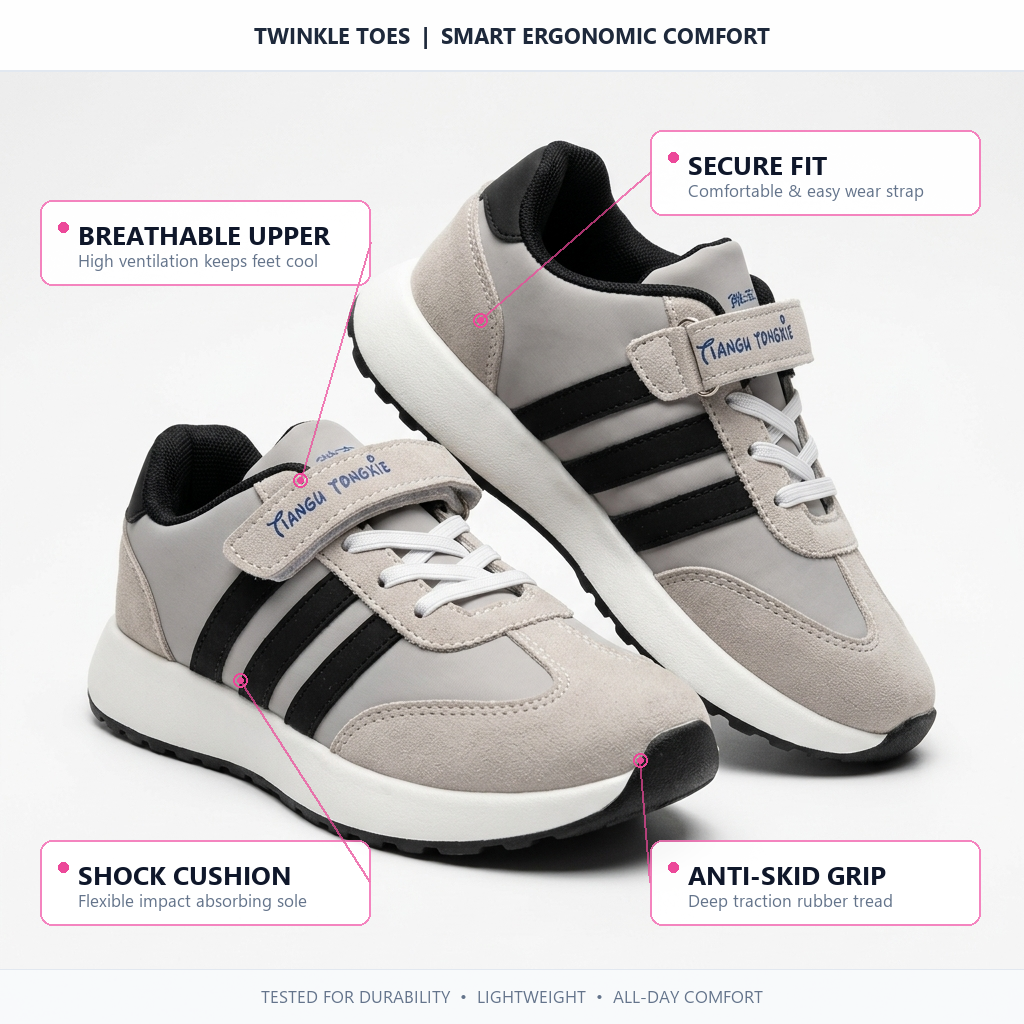
Explore TwinkleToes ergonomically crafted first walking shoes and kids casual sneakers, engineered with orthopedic-tested wide toe boxes and supportive heel counters.
Frequently Asked Questions (FAQ)
Q1. Can flat feet in toddlers be cured with special shoes?
In most cases, flat feet in toddlers are not a disease that needs “curing”—they are a natural developmental stage. Normal flexible flat feet self-resolve as the child grows and muscles develop between ages 4 and 7. Supportive shoes ensure comfort and proper alignment without needing rigid corrective braces.
Q2. How can I tell if my toddler’s shoes offer proper heel support?
Perform the “Pinch Test”: grasp the back cup (heel counter) of the shoe between your thumb and forefinger and squeeze. If the back easily folds flat like a sock, it lacks heel stabilization. A good shoe has enough structure to hold its shape.
Q3. Should toddlers with flat feet wear barefoot shoes?
For indoor play, being barefoot is ideal. For outdoors in India (rough roads, concrete, hot surfaces), lightweight shoes with flexible soles and a wide toe box allow the benefits of barefoot walking while shielding tiny feet from injury and shock.
Q4. Are Crocs or foam clogs okay for toddlers with flat feet?
Foam clogs are great for quick splash play or beach trips, but they lack the firm heel counters and midfoot stability needed for long walks or playground running. For active play, choose closed-back sneakers with Velcro straps.
Leave a Reply